
About 111 days a year at 100 degrees or more
Deck Builders in Phoenix, AZ
Shade comes first. Patio covers, covered decks and pergolas for Phoenix homes, framed for monsoon wind and drawn to the city's patio cover guideline.
- Free on-site estimates
- Written, itemized quotes before work starts
- Permit and HOA paperwork planned into the schedule
Why Phoenix Decks Start With Shade
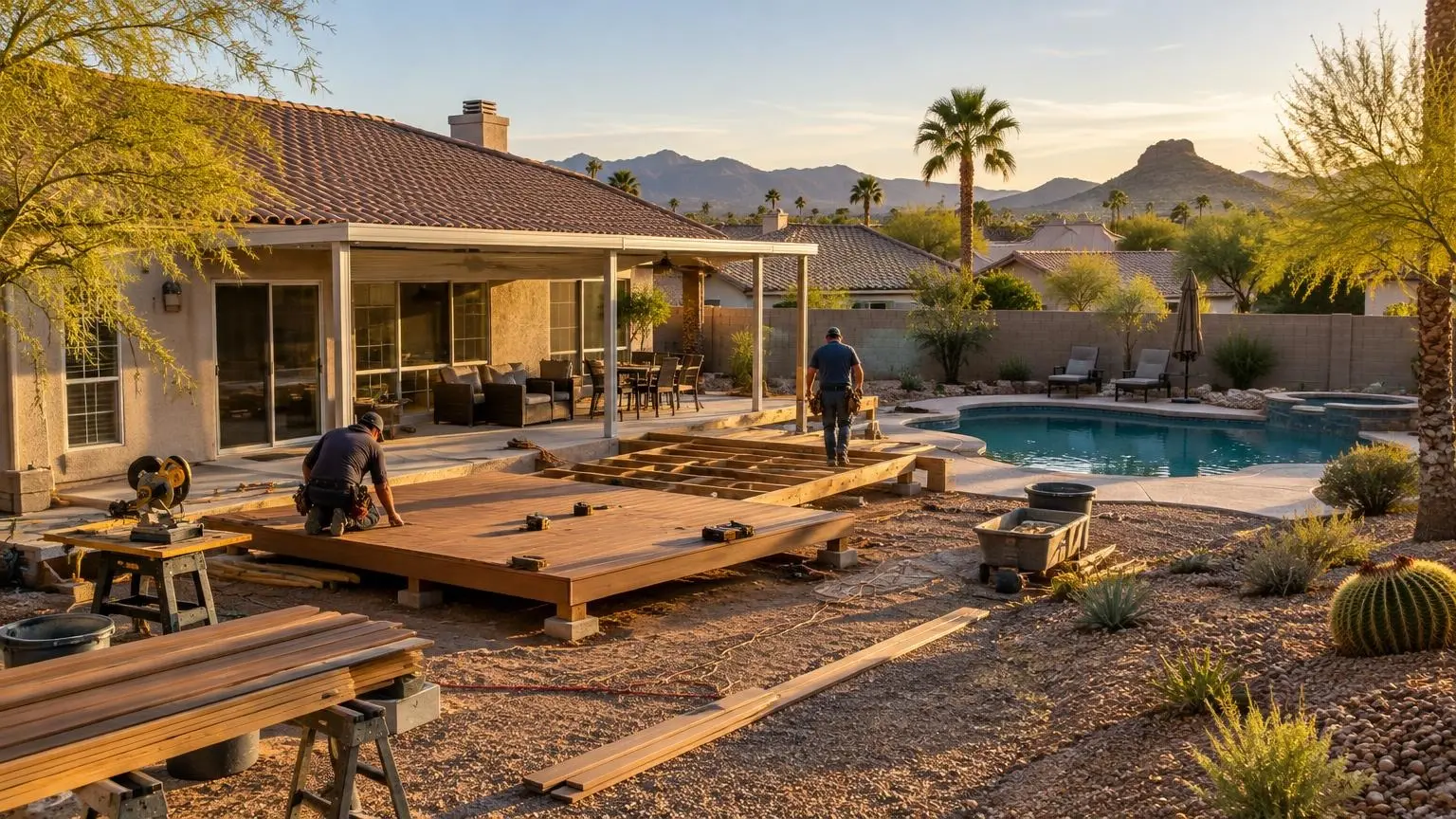
Deck Builders in Phoenix have to solve for heat before anything else. Wikipedia reports that Phoenix averages 111 days a year with highs of at least 100 degrees, and about 21 days above 110. The city set a record of 70 days at 110 or hotter in 2024. An uncovered deck in full sun simply goes unused for much of the year. That is why most of our Phoenix work starts with a patio cover or covered deck and builds the walking surface underneath it.
Hot nights, too. The same source explains that pavement and buildings store heat and release it after dark, so Phoenix nights stay warmer than a typical desert. The normal daily low stays at or above 80 degrees for an average of 74 days each summer. A shaded deck that has not been baking all afternoon is far more comfortable in the evening, which is when Phoenix families actually spend time outside.
Monsoon season. The National Weather Service set June 15 through September 30 as the official monsoon season in 2008. Storms in that window can bring heavy local rain, hail, flash flooding and destructive wind, and some dust storms reach haboob strength. For us, that means continuous load paths from rafters to footings, ICC-approved framing hardware installed to the manufacturer's specifications, and roofing that can shed a sudden downpour.
What the city's guideline requires. Phoenix's Residential Patio Covers Guideline (TRT/DOC/00620) covers one-story covers no more than 12 feet tall, open on two or more sides and attached to the home. It calls for a plot plan showing setbacks and lot coverage, a cross section, a roof framing plan and a foundation plan. Footings must go at least 12 inches below undisturbed ground, with minimum square footing sizes from a table, commonly 14 inches square and larger for longer spans. Open lattice or trellis must be pressure-treated lumber, and minimum roof slopes are listed by material, such as 2:12 for asphalt shingles. Permits stay valid for 180 days from issuance or the last inspection.
Extra approvals in some neighborhoods. The guideline adds steps for certain properties: hillside lots need grading and drainage approval, properties in a flood plain need floodplain management approval, and homes in historic preservation subdivisions need approval from the Historic Preservation Office, all before permit review. We check whether your address falls into one of those categories before you invest in drawings.
A city of villages. Phoenix covers 518 square miles and had an estimated 1,665,481 residents in 2025. It is organized into 15 urban villages, from Ahwatukee Foothills and South Mountain to Camelback East, Encanto, Deer Valley and North Gateway. Homes range from established areas like Arcadia and Sunnyslope to much newer subdivisions on the city's edges. About 57.3% of Phoenix homes are owner-occupied, with a median value of $420,700 (Census, 2020 to 2024). Those differences in age and lot size change what makes sense, from a compact covered deck in a central neighborhood to a large shaded platform on a bigger north Phoenix lot.
What we offer Phoenix homeowners
- Patio covers and covered decks sized to shade the space you use most
- Freestanding pergolas, with louvers or slats set for afternoon sun
- Composite decks in lighter colors and wood decks with UV-rated sealers
- Repairs and replacement of storm-damaged or sun-worn decks and covers
- Railings, stairs, staining and sealing
Free estimates. Call (480) 428-2835 or request an estimate online. Let us know which part of Phoenix you are in, and we will schedule a visit, measure the space and provide a written quote with the permit steps spelled out.
Phoenix Conditions to Plan Around
- Triple digits, most of the summer. Phoenix averages 111 days a year at 100 degrees or more and 21 days above 110. The record high is 122 degrees, set on June 26, 1990, and 2024 brought a record 70 days at 110 or hotter.
- Monsoon season dates. In 2008 the National Weather Service set June 15 to September 30 as Phoenix's monsoon season, with storms that can bring heavy local rain, hail, flash floods, destructive wind and dust storms.
- City patio cover guideline. Phoenix's Residential Patio Covers Guideline (TRT/DOC/00620) covers attached one-story covers up to 12 feet tall, requires plot, section, framing and foundation plans, and sets footings at least 12 inches below undisturbed ground.
- Extra reviews for some lots. Under the same guideline, hillside lots, flood plain properties and homes in historic preservation subdivisions need separate approvals before patio cover plans go to permit review.
- Detached structure threshold. The City of Phoenix lists patio covers and all detached structures larger than 200 square feet among residential projects that need a building permit.
Phoenix Questions
Does a patio cover need a permit in Phoenix?
Yes. The City of Phoenix lists patio covers among residential projects that need a building permit, and its patio cover guideline requires a plot plan, cross section, roof framing plan and foundation plan. We prepare the drawings and schedule the inspections.
How do you build covers to survive monsoon storms?
We use a continuous load path from roof framing to footings, ICC-approved hardware installed to the manufacturer's specs, and footings set at least 12 inches into undisturbed ground as the city's guideline requires. Monsoon season officially runs June 15 to September 30.
Is a freestanding pergola treated differently from an attached cover?
The city's patio cover guideline addresses attached covers, and Phoenix requires a permit for detached structures larger than 200 square feet. We confirm what applies to your design before construction starts.
I live in a historic neighborhood. What changes?
Homes in Phoenix historic preservation subdivisions need Historic Preservation Office approval before the patio cover permit goes to review. We help you plan a design that fits the house and build that step into the schedule.
Free Estimates in Phoenix, AZ
Free estimates across Phoenix's urban villages.
Deck Builders Near Phoenix
- Deck Builders in Tempe, AZ
- Deck Builders in Chandler, AZ
- Deck Builders in Mesa, AZ
- Deck Builders in Gilbert, AZ
- Deck Builders in Scottsdale, AZ
- Deck Builders in Ahwatukee, AZ
- Deck Builders in Guadalupe, AZ
- Deck Builders in Paradise Valley, AZ
- Deck Builders in Fountain Hills, AZ
- Deck Builders in Queen Creek, AZ
- Deck Builders in San Tan Valley, AZ
- Deck Builders in Glendale, AZ
- Deck Builders in Peoria, AZ
- Deck Builders in Surprise, AZ
- Deck Builders in Goodyear, AZ
- Deck Builders in Avondale, AZ
- Deck Builders in Laveen, AZ
- Deck Builders in Apache Junction, AZ
- Deck Builders in Gold Canyon, AZ
- Deck Builders in Sun Lakes, AZ
- Deck Builders in Cave Creek, AZ
- Deck Builders in Anthem, AZ
- Deck Builders in Litchfield Park, AZ